 Documentation-based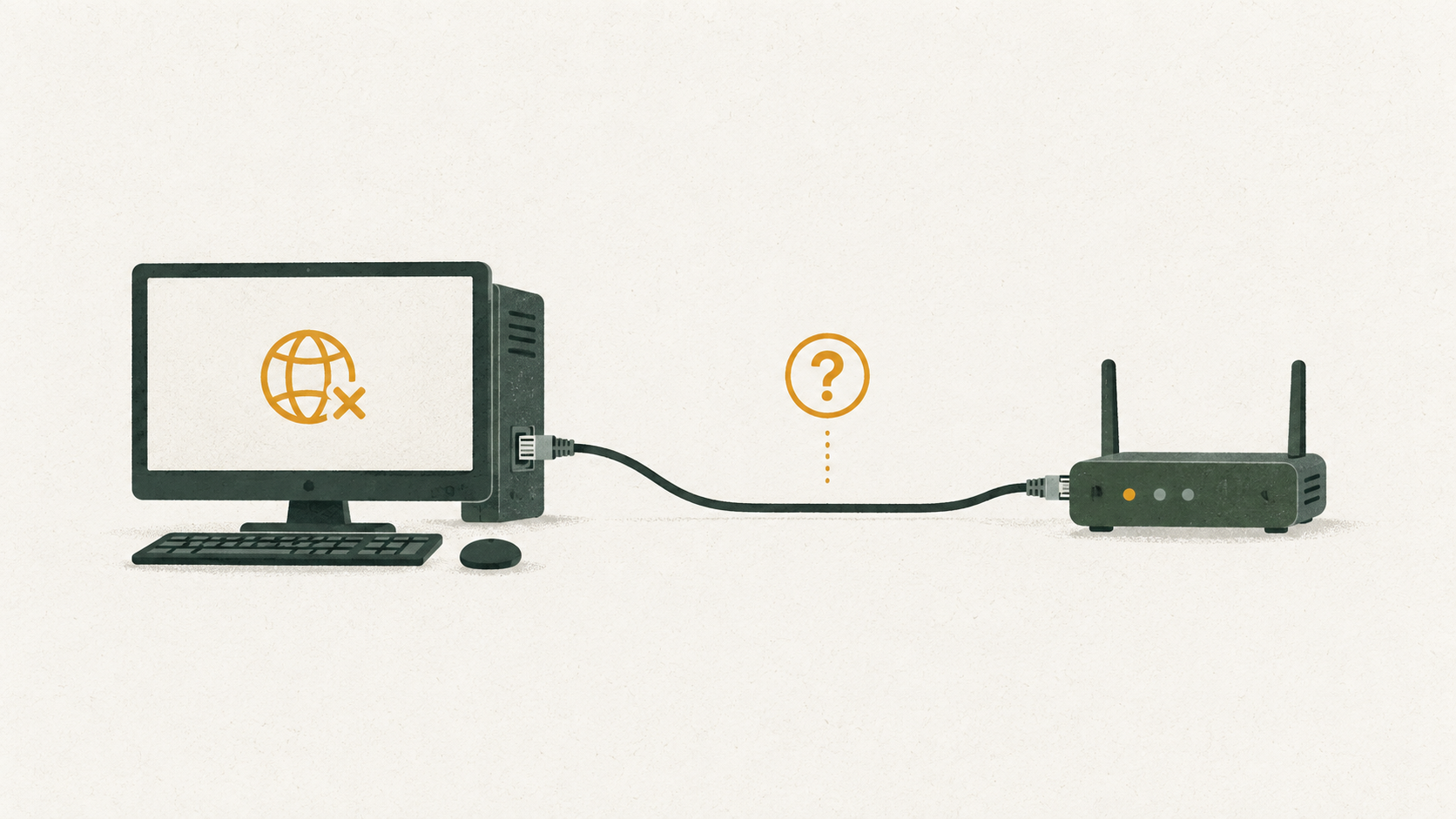
Based on Microsoft documentation and RFC 3927, reviewed September 19, 2026 with AI assistance. No hands-on hardware tests were performed. Alex Reed is a pen name.
Your Ethernet cable is connected, but Windows shows a 169.254 address and you cannot get online. First, check which adapter owns that address. Then check whether it uses DHCP, the service that supplies network settings.
When a Windows adapter configured for automatic addressing cannot obtain a DHCP response, it can assign itself an Automatic Private IP Addressing (APIPA) address. A 169.254 address on that adapter is a clue to investigate address assignment. It does not identify the faulty component. Microsoft explains APIPA.
This guide is for a personal Windows 11 PC on a home network. On a work, school, or managed building network, collect the observations below and contact its administrator before changing settings. Work locally at the PC; changing the connection can end a remote support session.
1. Find the affected Ethernet adapter
Open Command Prompt and enter:
ipconfig /allThis displays configuration details without changing them. Locate the Ethernet adapter connected to your cable. Read its heading and Description; avoid drawing conclusions from an unused VPN, virtual adapter, or Wi-Fi entry. Record DHCP Enabled, the IPv4 address, subnet mask, and Default Gateway from that same section. Microsoft's ipconfig reference describes the command and its options.
Use the following branches as an editorial diagnostic aid, not proof of a failed part:
| Your observation | Next check |
|---|---|
| The affected adapter says Media disconnected | Check the physical connection before attempting DHCP renewal. |
| DHCP Enabled says Yes and the adapter has an autoconfiguration 169.254 address | Continue with the comparison in section 2. |
| DHCP Enabled says No | Check whether someone intentionally configured a static address. See section 3. |
| Only an unused adapter has the 169.254 address | Inspect the active Ethernet adapter instead. |
| The Ethernet adapter already has its expected network address and gateway | Investigate the remaining internet or name-resolution problem; the starting symptom in this guide has changed. |
IPv4 link-local addresses in 169.254/16 are limited to the local link. They do not provide ordinary routed IPv4 internet connectivity. Another interface or working IPv6 can still complicate what you observe, so the address alone does not prove that every connection on the PC is offline. RFC 3927 defines the IPv4 link-local scope.
2. Compare the cable, port, and another device
Check both cable ends. On a home router, use a LAN port rather than its WAN/Internet port. Try a spare cable, then a different LAN port, recording each change. Microsoft includes cable checks and comparison with another PC in its Ethernet troubleshooting guidance.
If your usual route includes a wall jack, dock, or separate switch, draw that route before disconnecting anything. Where practical, compare a direct connection to your home router's LAN port. Keep the router between the PC and the provider's equipment.
Use these comparisons to choose where to investigate next:
| Comparison | Useful next step |
|---|---|
| Your PC obtains a DHCP address after changing only the cable | Repeat with the original cable. Note whether reconnecting it changes the result. |
| Another PC obtains an address using the same cable and port, but yours does not | Focus the next checks on your PC and any device-specific network rules. This does not prove that its adapter is broken. |
| Both PCs fail on the same route | Investigate the shared route and router before replacing a PC component. |
| Wi-Fi works, but Ethernet does not | Record that distinction. A working wireless connection does not establish that this wired path can obtain a DHCP lease. |
These are suggested comparisons, not measurements performed for this article. A second device that can browse the web may still be using an existing lease or another connection. Before treating it as evidence that DHCP works on this cable and port, confirm that it uses automatic addressing and can renew its Ethernet configuration using section 4. Do this only on a device you control. If a second device is unavailable, leave that observation blank.
3. Confirm the intended IP assignment
For a home network intended to use DHCP, open Settings > Network & internet > Ethernet. Select the connected Ethernet network if needed, find IP assignment, and choose Edit. The automatic option is Automatic (DHCP). See Microsoft's TCP/IP settings instructions.
Before changing a Manual configuration, record its address, subnet, gateway, and DNS settings privately. Confirm why they were set. If they belong to a managed network or a special device setup, stop and ask the person responsible. Do not replace them with numbers copied from another computer.
If this is your own home connection and it should use DHCP, save Automatic (DHCP), allow the connection to settle, then read the Ethernet section again. If changing from Manual causes a new problem, restore the recorded configuration through the same settings screen.
4. Request a new DHCP configuration for that adapter
Close calls and finish transfers first. On your own PC, open Command Prompt as administrator and run the following only if the adapter uses automatic addressing:
ipconfig /renew "Ethernet"Replace Ethernet with your adapter's connection name, not its hardware Description. For example, the heading Ethernet adapter Ethernet 2: uses the name Ethernet 2. Keep quotation marks around names containing spaces. Microsoft documents /renew for automatically configured adapters; naming one limits the request to that adapter. Read the result, then run ipconfig /all again. Command reference.
If the command reports that it cannot contact the DHCP server, save the exact error. Repeating the command without changing any condition does not tell you where the failure is. Return to the cable-and-port comparison or investigate the router's DHCP settings using documentation for its exact model.
A router restart interrupts other users. Coordinate it first, follow the manufacturer's restart instructions, and distinguish a restart from a factory reset. Do not press a reset pinhole as a routine troubleshooting step.
Changing DNS servers is not a substitute for obtaining the intended IPv4 configuration. Record the address-assignment result before moving to DNS troubleshooting; Microsoft's command reference distinguishes DHCP renewal from DNS cache operations.
5. Verify recovery on Ethernet
Record the Ethernet adapter's IPv4 address and gateway after renewal. For the home DHCP setup covered here, check that it has obtained an address in the router's configured LAN network rather than remaining on an autoconfiguration 169.254 address. Do not assume that every home uses 192.168.1.x, or that any non-169.254 address proves recovery. Confirm that the intended configuration is present and that the connection works.
Test the connection while you can distinguish Ethernet from other paths. At the PC, you can temporarily disconnect Wi-Fi if doing so will not interrupt essential work, then open the sites or service that failed. Reconnect Wi-Fi afterward if you normally use it. A working website alone does not prove that Ethernet recovered when another connection remains available.
After saving your work, restart the PC and repeat the address and connection checks. A result that fails again after restart needs further investigation.
Copy this static table into your notes and fill in your observations; the cells on this page are not input fields:
| Check | Your result |
|---|---|
| Adapter name and DHCP setting | |
| Original address and gateway | |
| Cable/port change made | |
| Renewal result or exact error | |
| Address and gateway after the change | |
| Ethernet-only connection check | |
| Result after restarting the PC |
If address assignment recovers but the wired link remains at 100 Mbps, continue with our Ethernet link-speed checks. That is a separate symptom.
6. Stop before making broader changes
If another PC works on the same connection and yours still fails, give support your adapter model, driver version, renewal error, and comparison results. Remove host names, MAC addresses, and unrelated adapter details before posting logs publicly.
Download the correct manufacturer driver before uninstalling an adapter. Reserve Windows Network reset for a later, deliberate step: it removes adapter settings, and VPN or virtual-network software may need setup again. Microsoft describes these precautions in its Ethernet support guide.
On a managed network, send the administrator the affected port, time of failure, adapter details, and exact error. Ask them to check the DHCP service and the rules for that wired connection. Leave the network's authentication and security controls in place.
Sources and method
Sources reviewed September 19, 2026. This article combines Microsoft documentation, the IPv4 link-local standard, and an editorial sequence of controlled comparisons. The older Microsoft APIPA document supports the addressing concept; current Microsoft Windows instructions support the settings and commands. No hands-on hardware tests were performed. Alex Reed is a pen name. The comparison tables contain guidance and blank fields, not fabricated results.
- Microsoft: Automatic TCP/IP addressing without a DHCP server
- Microsoft: ipconfig
- Microsoft: Essential network settings and tasks
- Microsoft: Fix Ethernet connection problems
- RFC Editor: RFC 3927
