
 Documentation-based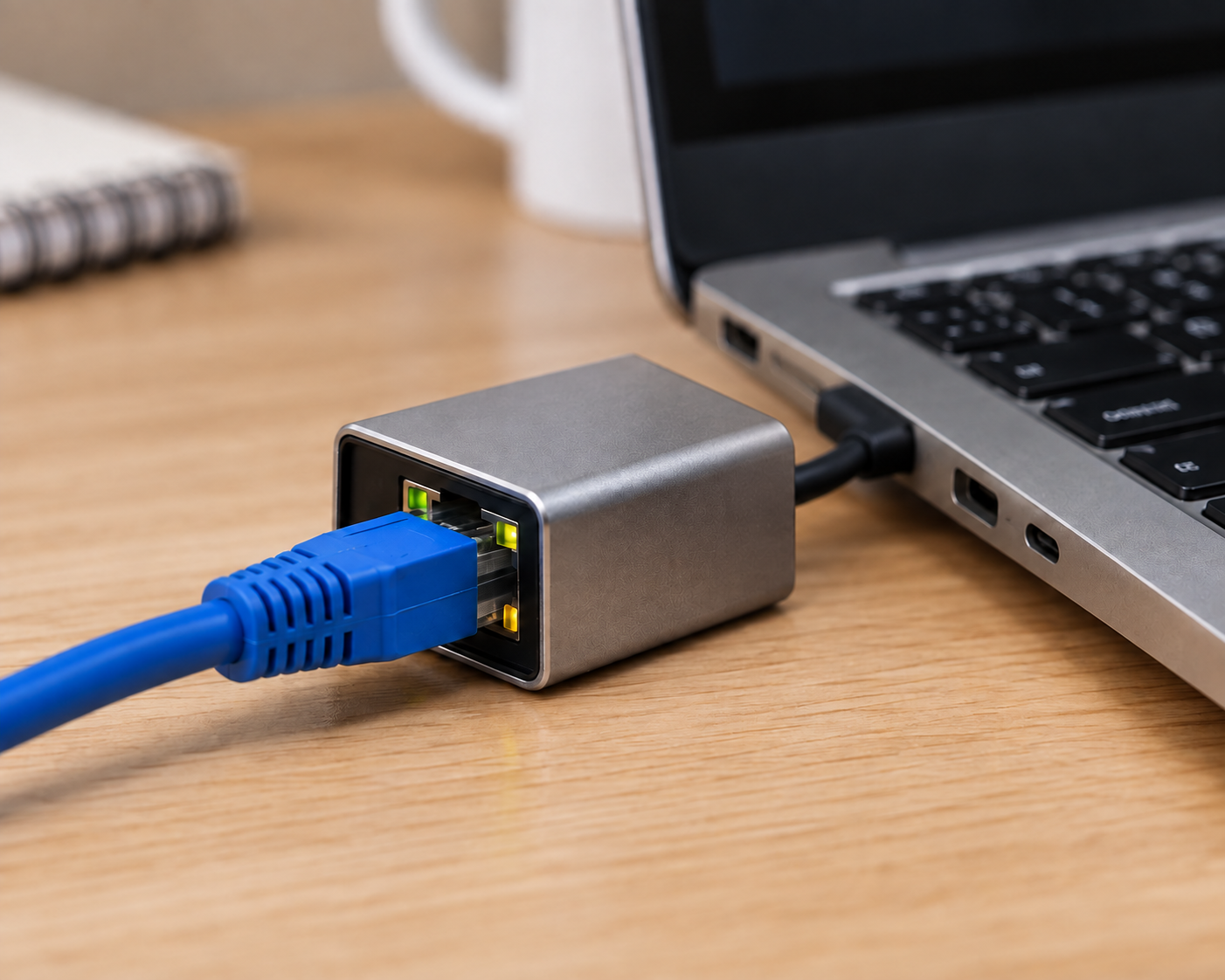
Based on manufacturer documentation, reviewed September 19, 2026 with AI assistance. No hands-on hardware tests were performed. Alex Reed is a pen name.
You pay for a faster internet connection, but Windows shows an Ethernet link speed of 100 Mbps. Start by checking the connection between your PC and the next network device. A gigabit internet plan cannot make that local link run at 1 Gbps.
Check the port specifications, try a cable that has worked at gigabit speed, and compare the results after each change. Leave Speed & Duplex on Auto Negotiation unless your hardware manufacturer gives different instructions for your setup.
1. Check the Ethernet link speed
Open Windows PowerShell and run this read-only command:
Get-NetAdapter -Physical | Format-Table Name, Status, LinkSpeedFind your connected Ethernet adapter. Ignore Wi-Fi entries. The name might be Ethernet, Ethernet 2, or a name you assigned. Microsoft documents Get-NetAdapter as a way to inspect network adapters; the -Physical parameter limits the results to physical adapters. [1]
For a graphical view, open Control Panel, then Network and Internet > Network and Sharing Center. Select your active Ethernet connection and look at Speed. [2]
| Reading | Meaning | Next step |
|---|---|---|
| 100 Mbps | The PC's current Ethernet link runs at 100 Mbps. | Continue with the cable and port checks below. |
| 1 Gbps or higher | The PC has negotiated a faster local link. | Check the rest of the network and your internet service if downloads remain slow. |
| Disconnected | The adapter has no active connection. | Check cable seating and whether the connected device has power. |
Link speed describes one connection: your PC to the device at the other end of its cable. If you use a switch, Windows reports the PC-to-switch link. A slower switch-to-router connection can still limit internet traffic. [3]
Also check the units in your download app. Mbps means megabits per second; MB/s means megabytes per second. Dividing 100 Mbps by eight gives 12.5 MB/s before protocol overhead. A download near that rate does not mean a 100 Mbps link has lost most of its capacity. [3]
2. Check the ports you are using
Look up the exact model of your Ethernet adapter and the device it plugs into. Check the wired port specifications, even if the router advertises high Wi-Fi speeds. A 10/100 port supports up to 100 Mbps; a 10/100/1000 port supports gigabit Ethernet. [3]
Include a USB Ethernet adapter or dock in this check. Its Ethernet port may have a different limit from the PC's built-in port. If you find a 100 Mbps port in the path, a Windows setting cannot turn that port into gigabit hardware.
For the next test, connect the PC to a gigabit LAN port on your home router with one cable. Bypass a wall socket, coupler, or separate switch where practical. Use a LAN port, not the router's WAN or Internet port.
Before unplugging anything, finish downloads and calls. Label the original cable and port so you can restore the connection afterward. Keep the router between your PC and your internet provider's equipment.
3. Compare one cable and port at a time
A cable marked Cat 5e or Cat 6 can support gigabit Ethernet. The printed category does not confirm the condition of its connectors or wiring. TP-Link specifies gigabit support for its Cat 5e cable, so Cat 6 is not a universal requirement. [4]
Use a spare cable that has already produced a 1 Gbps link on another device, if you have one. A new cable is useful for comparison, but you have not yet verified it.
Start with the original cable and record the link speed. Replace only the cable, wait for the connection to return, and run the command again. Then keep that replacement cable and try another gigabit LAN port. Intel includes cable, network, and second-system comparisons in its troubleshooting guidance. [5]
Use this worksheet to record your own results. The blank cells are for your measurements.
| Test | Connection | Link speed |
|---|---|---|
| A | Original cable and original port | |
| B | Known-good cable and original port | |
| C | Same known-good cable and another gigabit LAN port | |
| D | Another gigabit-capable PC using the cable and port from C |
Only run D if another suitable computer is available. Keep the cable and port fixed during that comparison. If you change several parts together, you can establish that another setup works, but you cannot tell which change made the difference.
4. Read the comparison results
The following table is a diagnostic aid, not a record of tests performed for this article. Treat each result as a reason to narrow the next check, rather than proof that a component has failed.
| Your result | What to check next |
|---|---|
| B reaches 1 Gbps and A stays at 100 Mbps | Recheck the original cable and its connectors. Repeat A and B to see whether reseating alone changes the result. |
| C reaches 1 Gbps but B stays at 100 Mbps | Check the original port's specification and configuration. Repeat the port comparison with the same cable. |
| A direct router connection reaches 1 Gbps, but the normal route does not | Add the bypassed switch, wall connection, and cables back one at a time. Record where the slower link returns. |
| D reaches 1 Gbps while your PC stays at 100 Mbps | Focus on your PC's port, adapter settings, and driver. This result does not distinguish a driver problem from hardware trouble. |
| Both PCs stay at 100 Mbps | Recheck the shared cable and port. Confirm that the comparison PC and both ports support gigabit Ethernet. |
If the same setup alternates between 100 Mbps and 1 Gbps, record when it changes: after reconnecting the cable, restarting Windows, or waking from sleep. An intermittent result needs repeated checks before you blame one part.
5. Check Speed & Duplex and the driver
Open Device Manager, expand Network adapters, and open your Ethernet adapter's Properties. Under Advanced, look for Speed & Duplex. Record its current value before changing it. For Intel gigabit adapters, Intel recommends Auto Negotiation. [5]
Applying this setting can interrupt the connection. Do it while you have physical access to the PC, not during a remote session that depends on that adapter. On a work-managed PC, ask IT before changing network settings.
Some Intel drivers do not offer a separate 1.0 Gbps Full Duplex choice. Its absence does not establish that the adapter lacks gigabit support. Intel explains that Auto Negotiation can establish a gigabit link when the connected equipment supports it. [5]
If your adapter uses different labels or has no such option, check its manufacturer's documentation. Avoid copying advanced settings from an unrelated adapter.
If your cable and port comparisons point toward the PC, download the Ethernet driver for your exact PC, motherboard, or adapter model from its manufacturer's support site. Save the installer before making changes in case you lose network access. Microsoft also recommends having a backup driver available before uninstalling an adapter driver. [6]
Install the appropriate driver according to the manufacturer's instructions, restart if requested, and repeat the same cable-and-port test. Note the driver version and result. Changing the driver and the physical connection together would make the outcome harder to interpret.
6. Verify the result and decide when to stop
After a successful change, check the link speed again after a restart. If the problem appeared after sleep, include a sleep-and-wake check. Then restore the normal network route and confirm that it still works at the expected link speed.
Run an internet speed test afterward. A 1 Gbps local link does not guarantee 1 Gbps internet throughput: the internet plan and other links along the route still matter. [3]
Stop changing Windows settings once you have identified a port limited to 100 Mbps. If your PC stays at 100 Mbps on a connection that another gigabit PC uses at 1 Gbps, send the PC or adapter manufacturer your comparison table, adapter model, and driver version. Those details give support a specific failure to investigate.
Reserve a full network reset for broader connection problems. Microsoft lists it as a last step because it removes installed network adapters and their settings; you may need to set up networking software again afterward. [6]
Sources and method
This guide uses manufacturer documentation and an editorial troubleshooting sequence. It does not report hands-on hardware tests. The worksheet is for your own observations. Sources checked September 19, 2026.
1Microsoft Learn: Get-NetAdapter ↗
2Intel: Ethernet Link Speed Capped at 100 Mbps ↗
3TP-Link: Router Internet Speed and Wi-Fi FAQs ↗
4TP-Link: Cat5e Cable Datasheet ↗
5Intel: Ethernet Adapter Limited at 100 Mbps ↗
6Microsoft Support: Fix Ethernet connection problems in Windows ↗
